
Landslide Risk Management

Regulators Quiz

This module of the website is aimed at the Regulator who have the responsibility for setting risk criteria, administering planning controls and approving development proposals under the requirements of specific planning controls or a policy.

The format of the module is for a series of Questions relating to the understanding required by the Regulator in respect to a number of aspects relating to the implementation of a landslide-zoning scheme, policy requirements and the approvals process.

Question 10 of 10

10. What Risk Criteria and Levels does the AGS recommend for consideration by the regulator?

  • AGS doesn't recommend any criteria
  • AGS provides only general comment on this issue
  • AGS recommends specific risk criteria for the consideration of the regulator
  • Only the State and Federal governments provide recommendation for risk criteria

Whilst the final choice of risk criteria lies with the regulator, The AGS guidelines provides advise on risk criteria for consideration in the absence of state and federal advice on the subject.

10. What Risk Criteria and Levels does the AGS recommend for consideration by the regulator?

The regulator is responsible for setting the Risk Criteria for loss of life and property loss.

AGS 2007c (page 68)

Currently there is no known risk criteria which have been set by any state government in Australia nor by the Federal government.

After due consideration of the benefits and costs of risk mitigation and the sometimes high potential costs to achieve acceptable risk and taking account of the criteria which were included in AGS (2000, 2002), AGS suggests that for most development in existing urban areas criteria based on Tolerable Risks levels are applicable because of the trade-off between the risks, the benefits of development and the cost of risk mitigation.

The recommended Tolerable loss of life risk values for the person most at risk for different situations are shown in Table 1 of the Practice Note.

Table 1: AGS Suggested Tolerable loss of life individual risk.

AGS 2007c (page 77)

It is recommended that risks be assessed only for the person most at risk.

The recommended values are higher for existing slopes than for new slopes.

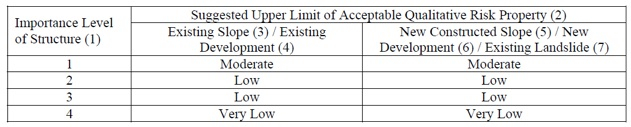
Regulators may decide to apply “acceptable risk” criteria for high consequence cases, such as schools, hospitals and emergency services in recognition of the importance of these structures and as a way of covering societal risk concerns. This is also reflected in the recommended criteria for property loss for different Importance Levels of structures presented in table C10 in the Commentary on the practice note.

Table C10: AGS suggested Acceptable qualitative risk to property criteria.

Notes

  1. Refer to Appendix A, Practice Note
  2. Based on Appendix C, Practice Note
  3. “Existing Slopes” in this context are slopes that are not part of a recognizable landslide and have demonstrated nonfailure performance over at least several seasons or events of extended adverse weather, usually being a period of at least 10 to 20 years.
  4. “Existing Development” includes existing structures, and slopes that have been modified by cut and fill, that are not located on or part of a recognizable landslide and have demonstrated non-failure performance over at least several seasons or events of extended adverse weather, usually being a period of at least 10 to 20 years.
  5. “New Constructed Slope” includes any change to existing slopes by cut or fill or changes to existing slopes by new stabilisation works (including replacement of existing retaining walls or replacement of existing stabilisation measures, such as rock bolts or catch fences).
  6. “New Development” includes any new structure or change to an existing slope or structure. Where changes to an existing structure or slope result in any cut or fill of less than 1.0 m vertical height from the toe to the crest and this change does not increase the risk, then the Existing Slope / Existing Structure criterion may be adopted. Where changes to an existing structure do not increase the building footprint or do not result in an overall change in footing loads, then the Existing Development criterion may be adopted.
  7. “Existing Landslides” have been considered likely to require remedial works and hence would become a New Constructed Slope and require the lower risk. Even where remedial works are not required per se, it would be reasonable expectation of the public for a known landslide to be assessed to the lower risk category as a matter of “public safety”.
  8. Tolerable risk levels would be one class higher (for example Moderate where Low is acceptable). Consideration should be given by regulators to adopting Tolerable risk to property for Existing Slope and Existing Development situations in a similar vein to the recommended differentiation for risk to life.