
Landslide Risk Management

General Public Quiz

This module is directed towards members of the general public of Australia, with particular relevance to those interested in the potential impact of landslide events upon themselves, or upon their property.

This module is particularly to provide a broad introduction to the philosophy and concepts embedded within the broad topic of risk management as it applies to landslides within Australia.

This module is applicable to you if you:

  • Are involved with a building development within a local government area that is prone to landslide events (of one form or another) and are required to have a landslide risk assessment conducted prior to gaining building approval; or
  • Are adjacent to (beside, above or below) a proposed development which requires a landslide risk assessment prior to its approval, and you are therefore an interested party; or
  • You are aware of landslide hazards within public property; or
  • You are interested in the topic in general terms;

The format of this module is a series of questions to step you through the concepts involved in Landslide Risk management (LRM) and to familiarise you with the terminology and jargon that you may encounter.
Question 4 of 10

4. What is Landslide Risk Management?

  • something imposed upon me by regulators during the Development process.
  • a means of allowing me to be aware of the risk scenario relevant to potential landslides that may impact upon me, my family and friends.
  • a means to protect regulators from making decisions.

An appropriate axiom to bear in mind is forewarned is forearmed

4. What is Landslide Risk Management?

A means for me to be aware of the landslide risk setting as it may influence me, my family and friends, and my community in general.

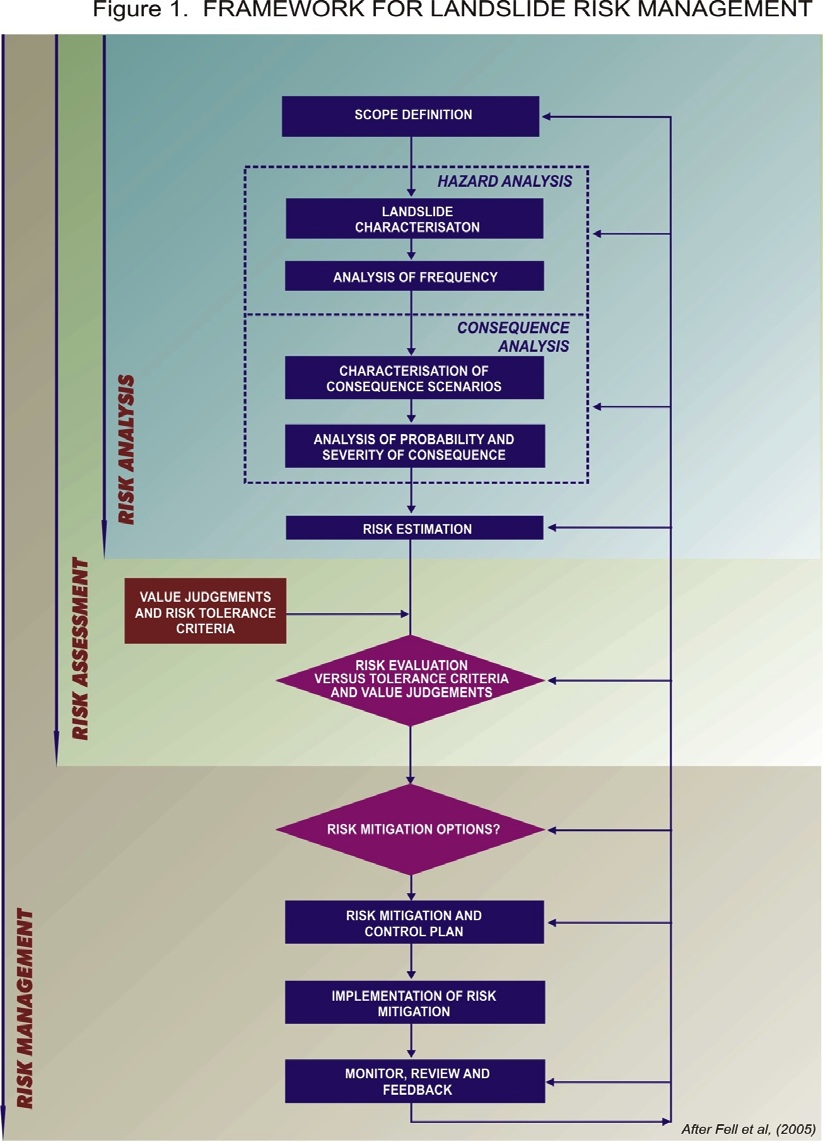
There are a number of elements in the Landslide Risk Management (LRM) process. The process covers:

  • Determination of potential landslide nature and characteristics of such landslides — hazard identification;
  • Performance of a landslide frequency analysis for each scenario — landslide susceptibility;
  • Performance of a consequence analysis by determining the elements at risk (property, persons, environment), and determine the temporal probability and the vulnerability of the various elements — consequence analysis;
  • Estimation of the risk for each scenario;
  • Collectively to this stage, this is termed “risk analysis”;
  • Comparison of the assessed risk s to acceptable or tolerable risk levels — termed “risk evaluation”;
  • Collectively to this stage, this is termed “risk assessment”;
  • Inclusion of treatment options, development and implementation of a treatment plan (if required), management of the intervention measures and verification of the efficacy of the treatment options and as-found issues;
  • Which is collectively termed Landslide Risk Management.

This is demonstrated diagrammatically on Risk Framework:

Risk Managment Figure1

Landslide Risk Management permits an assessment of the risk environment of a property or individual in the context of landslide scenarios to be determined. A determination can then be made as to whether the risk levels are acceptable or tolerable to determine the style and extent of intervention measures that may be required within a defensible management framework.